

Buildings: Residential and Commercial
Behavioral Science to Encourage Energy Savings in Buildings

Buildings: Residential and Commercial
Behavioral Science to Encourage Energy Savings in Buildings
Unlocking Buildings' Energy-Saving Potential
Many behaviors can be changed in buildings to reduce energy consumption. These can range from repeated, minor actions, like washing laundry in cold water, to larger one-time behaviors, like investing in energy upgrades. Residential building owners, single or multifamily, can do each. Renters can encourage their landlords to take advantage of energy upgrade rebates and tax credits (or do it themselves!). Residents and building operators can be trained to spot and act on energy efficiency opportunities. A campaign can be created to get workers to save energy at their places of business. Whether it’s changing messages or changing systems, BEAR Hub can provide the support you need.
Have a buildings program you'd like to talk to us about?
Apply for our technical assistance program!
Case Studies

Increasing Energy Benchmarking Compliance
The City and County of Honolulu has implemented a benchmarking ordinance requiring owners of mid-sized buildings to annually report their buildings’ energy use and greenhouse gas emissions through ENERGY STAR Portfolio Manager®️. Benchmarking helps building owners understand energy performance and is the first step toward improving building efficiency and reducing related emissions. In the year prior to BEAR Hub assistance, only 40% of buildings complied with the ordinance. Honolulu partnered with BEAR Hub in 2026 to identify strategic opportunities to increase compliance without relying on fines.
Key Takeaways
Enhancing communications and adding an easy first step doubled compliance among buildings who had not previously complied.
Between January and June, benchmarking compliance more than tripled with BEAR Hub assistance (3.6 times higher) relative to the previous year.
When building owners have complied in the past, they are 21 times more likely to do it again.
STEP 1: IDENTIFY A SPECIFIC BEHAVIOR TO CHANGE
BEAR Hub recognized that the target behavior differed depending on a building’s compliance history. Building owners who had previously benchmarked their buildings only needed to update their information—a process that typically takes 15 minutes. In contrast, building owners who are benchmarking for the first time face a multi-step process in setting up their accounts and familiarizing themselves with the process, which takes up to three hours to complete.
STEP 2: IDENTIFY BARRIERS & BENEFITS FOR THE TARGET AUDIENCE
BEAR Hub reviewed the materials provided by Honolulu and spoke extensively with City staff to audit the benchmarking process and identify key barriers to compliance.
First, the initial benchmarking process is inherently highly complex and burdensome, and it was not feasible for Honolulu to reduce that burden directly. Existing communications may have reinforced this sense of difficulty by including more information than recipients needed at the outset. BEAR Hub hypothesized that the perceived effort and uncertainty created substantial friction, leading building owners to postpone, avoid, or abandon the task altogether.
Second, Honolulu was often uncertain whether its communications were reaching the individual responsible for completing the benchmarking requirement. Notices were typically sent to building owners or mailing addresses, but the person responsible for benchmarking may have been a property manager, facilities manager, or other representative. Even building owners who were motivated to comply could fail to do so if the information never reached the right person.
STEP 3: BRAINSTORM, PRIORITIZE & SELECT BEHAVIOR CHANGE STRATEGIES
To reduce the perceived complexity of getting started on benchmarking, BEAR Hub recommended testing a redesigned compliance pathway that started with a much simpler and easy “first step” for first-time benchmarkers.
For building owners who had never done benchmarking before, the communications would no longer be directing recipients to complete the entire benchmarking process. Instead, recipients were directed to complete a three-minute online contact form—the “first step” toward compliance. Once that form was submitted, City staff could contact the self-selected building representatives directly and guide them through the remaining steps in the process.
This approach could, in theory, lower the psychological barrier to starting while also helping Honolulu update its contact list with the correct person to contact for follow-up.
BEAR Hub also recommended simplifying communications materials to reduce information overload and introducing a stronger sense of urgency later in Honolulu’s messaging campaign as the compliance deadline approached.
STEP 4: IMPLEMENT THE BEHAVIOR CHANGE STRATEGIES
BEAR Hub provided a brief literature review on the topic of communication about ordinances and proposed a method for potentially increasing compliance as well as a method for evaluating success using a randomized controlled trial.
BEAR Hub designed a messaging experiment in which buildings were assigned to one of four groups. Buildings were first divided based on their prior compliance history: those that had benchmarked in previous years and those that had never complied. Then they were assigned to a treatment or control group within each category. Thus, two groups received the City’s standard communications, and two treatment groups received the redesigned and simplified communications including a simplified “Step 1” compliance pathway for first-time benchmarkers.
BEAR Hub collaborated with Honolulu to redesign every communication across the campaign. This consisted of six fully redesigned messaging materials (two letters and four email notices), as well as updated web resources. These new materials simplified communications and included a stronger sense of urgency in later message content and design elements.
STEP 5: EVALUATE THE PROGRAM TO ITERATE AND IMPROVE
The evaluation results show that simplifying the initial action request substantially improved compliance among first-time benchmarkers.
First, as expected, those who had complied in the previous year were much more likely to comply. We found a statistically significant difference between previously complied buildings and never-complied buildings who received the same communications: returning benchmarkers were 21 times more likely to submit benchmarking reports than buildings attempting the process for the first time.
Second, BEAR Hub’s redesigned approach worked significantly better than the previous year’s approach. Buildings that received the revised communications and simplified Step 1 instructions were nearly twice as likely to comply than those receiving the old communications, a statistically significant difference.
Third, the Step 1 process proved valuable in two ways. It identified the person responsible for completing benchmarking, providing Honolulu with accurate contact information that allowed staff to follow up directly with buildings that had not yet complied via email or phone call. Step 1 also was associated with increased commitment to finishing the process. Among buildings asked to complete Step 1, 14% did only Step 1 and 28% completed all their benchmarking requirements (compared to only 17% who completed benchmarking using the previous year’s communications without being asked to do Step 1). Thus, more buildings were benchmarked under the new process, and even more can be directly contacted to complete benchmarking going forward.
Those who completed Step 1 were also statistically significantly more likely to complete the full benchmarking process than those who did not, despite Step 1 making the whole process a little longer and more effortful. Most buildings that completed Step 1 finished benchmarking without requiring a phone call, but those that received calls were more likely to follow through. Therefore, direct follow-up further increased completion among those that still needed assistance.
Overall, benchmarking compliance between January and June was 3.6 times higher with BEAR Hub’s recommendations than during the same period the previous year. Even after a six-month extension to the deadline the previous year (increasing the success rate to 42% over 10 months), compliance during the BEAR Hub-supported year still outpaced the previous year in roughly half the time (51% compliance over 6 months). Simplifying communications, adding urgency, and lowering the effort required to get started substantially improved compliance without relying on fines.
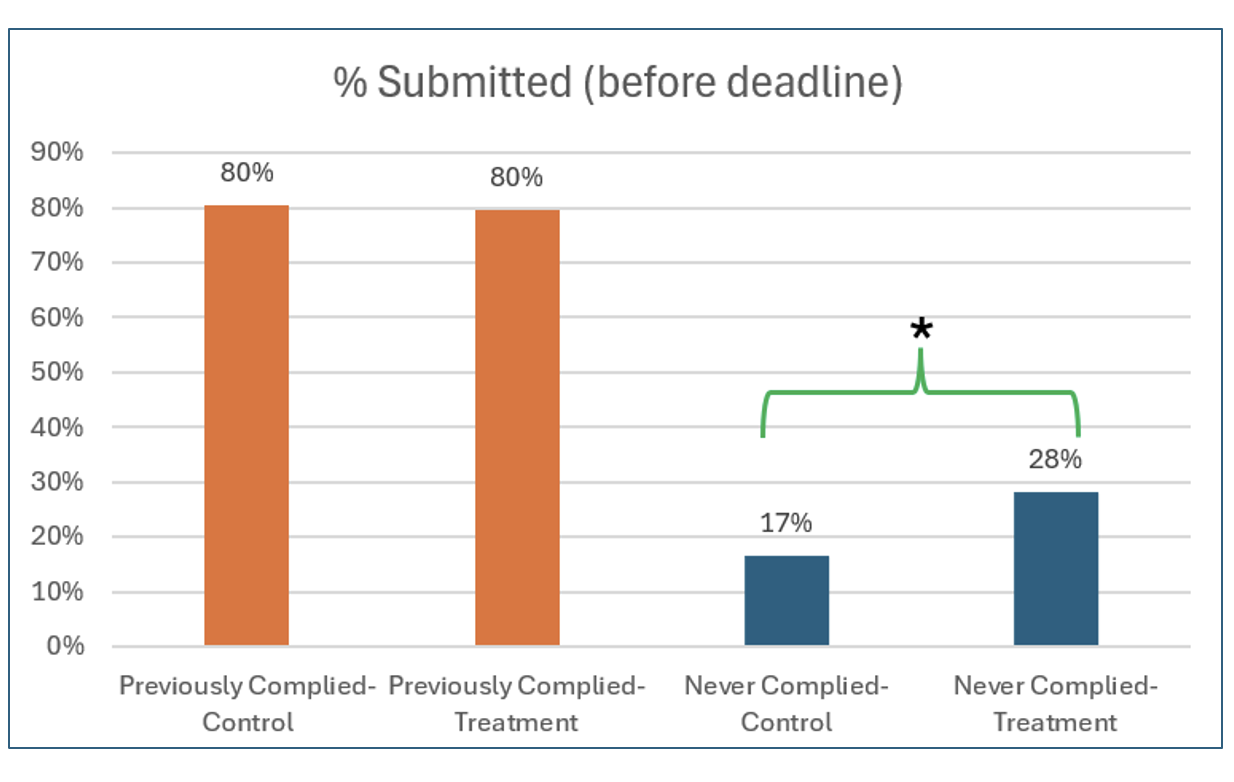
Among buildings that had never previously complied, significantly more complied when we simplified the communications, added a simple first step, and increased the urgency message in the final postcard communication. Among buildings that had previously complied, simplifying communications and adding urgency to the final postcard did not increase the (already high) rates of compliance.
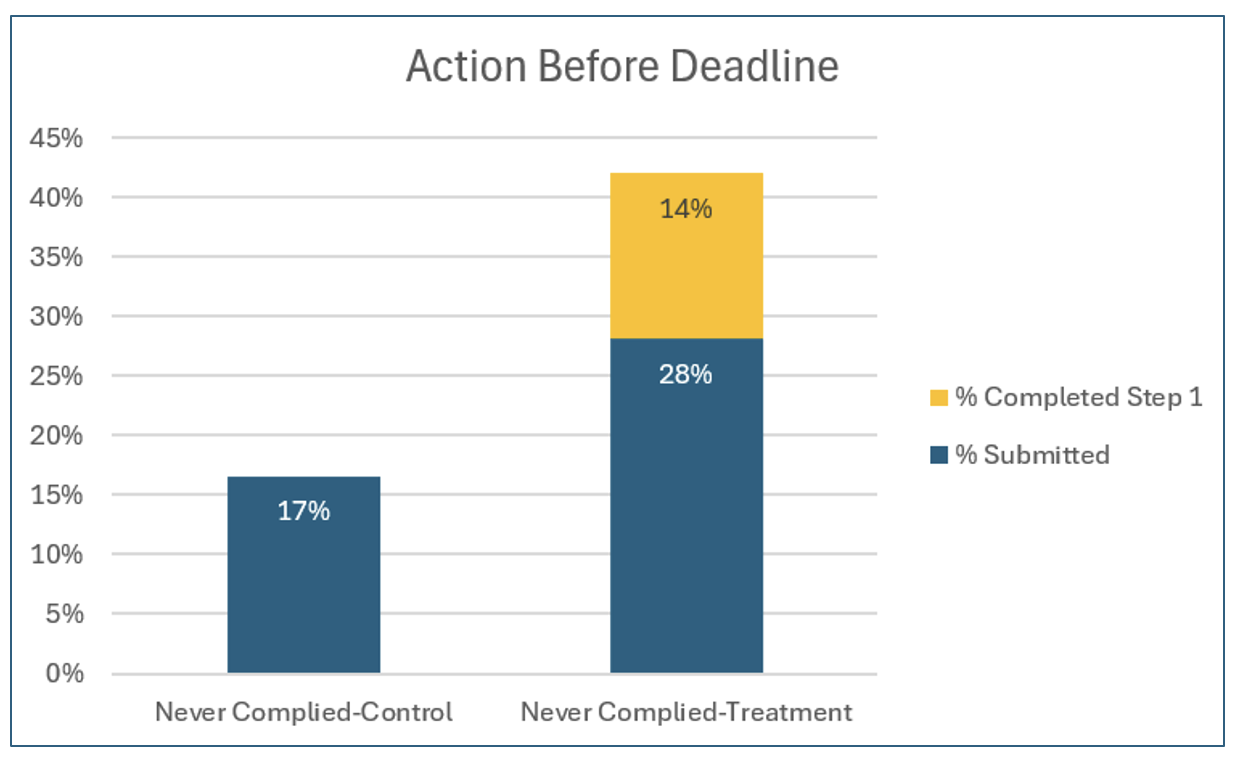
Among buildings that had never previously complied, BEAR Hub-edited materials resulted in significantly more submitting their materials before the deadline, and even more completing the simple first step, allowing efficient follow-up for more compliance.
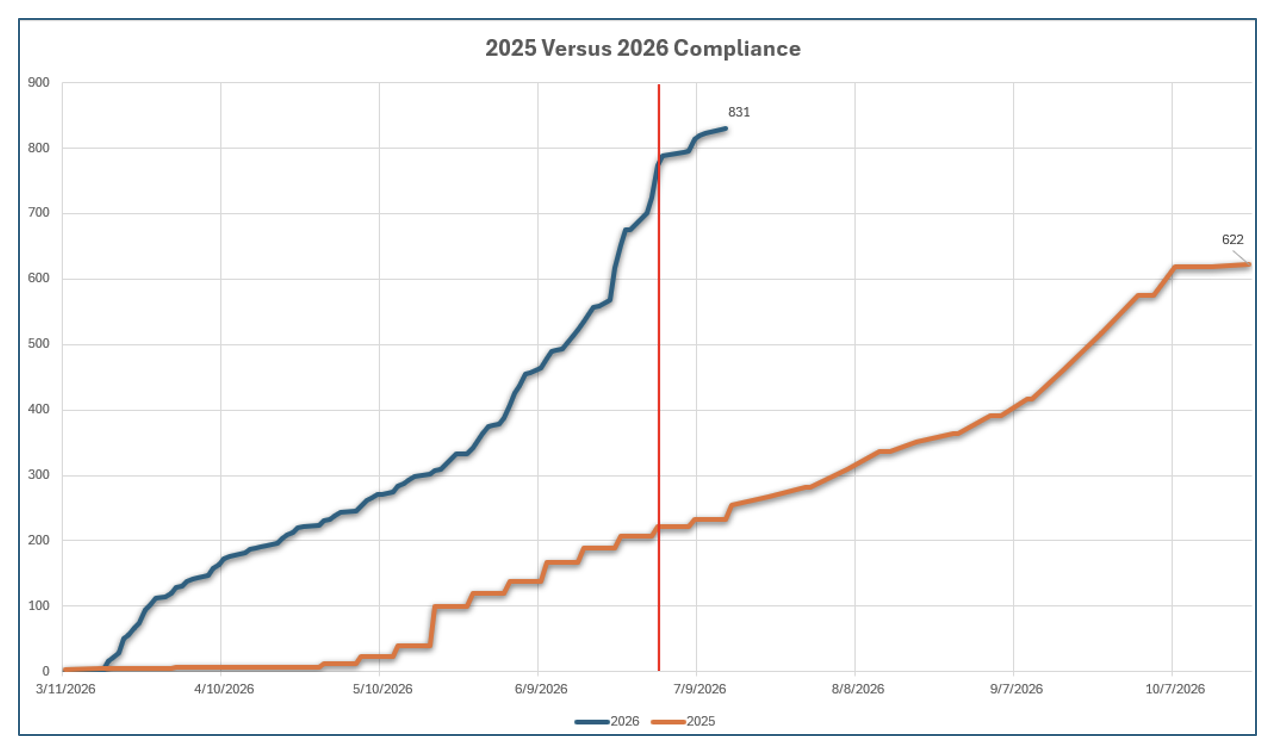
Red line indicates deadline to comply (June 30). In 2025, the original deadline was extended to September 30.
“Bear Hub has transformed Honolulu’s communication strategy by dissecting it into clear, actionable components and pinpointing exact weaknesses in our written messaging. Their iterative approach (testing and refining solutions with program specific input) has delivered practical outcomes that have dramatically improved our public communication strategy. The value of this partnership is evident in the smoother workflows, higher stakeholder engagement, and the expected boost in the City & County of Honolulu’s compliance numbers.” – Nick Gladfelter, Office of Climate Change, Sustainability & Resiliency, Honolulu
Helping Low-Income Ohioans Get Energy Assistance
EmpowerSaves uses data analysis to identify Ohio households likely to qualify for and need energy programs serving low-income households, such as bill assistance or weatherization programs. It then sends those households targeted communications to help them enroll. This key capability was used to identify the potential households that would benefit from the Ohio Winter Crisis Program.
With the target population identified, BEAR Hub and EmpowerSaves focused on the next behavioral challenge: how to motivate likely-qualified households to take action. EmpowerSaves provided a streamlined online intake form that interested households could complete, which could then be forwarded to the community action agency for program follow-up.
Key Takeaways
Using a small number of high-performing messages, we solicited intake forms from a higher percentage of households than last year at 1/3 the cost (4.2% vs 3.4%).
Closing the gap between intake form completions and applications may be the key to helping more households. 4.2% completed an intake form but 2.1% applied.
The first message and the last week of messages performed best. Sending messages on the coldest days might also help. Sending more messages is not necessarily better.
STEP 1: IDENTIFY A SPECIFIC BEHAVIOR TO CHANGE
EmpowerSaves created a simple online intake form that interested households could complete and that EmpowerSaves could then forward to the community action agency for program follow-up.
The primary target behavior was increasing completion of the online intake form among households identified as likely eligible for assistance. However, the form was not the only pathway to program participation (households could contact the community action agency directly in person or by phone). Ultimately, BEAR Hub targeted and evaluated two behaviors: intake form completions and program applications at the community action agency.
STEP 2: IDENTIFY BARRIERS & BENEFITS FOR THE TARGET AUDIENCE
BEAR Hub reviewed previous outreach campaigns, existing research, and EmpowerSaves communications data to understand why more eligible households were not taking the next step.
The behavioral diagnosis identified trust as a common and major barrier to participation, so communications would need to be designed to prioritize credibility, legitimacy, and trust to build confidence and reduce skepticism.
BEAR Hub also identified several potential behavioral motivators that could be tested and strengthened through communications, including personalizing expected financial savings, communicating urgency around the limited enrollment windows, and describing social norms to normalize applying for assistance. Some previous communications incorporated messages on these topics and were potentially excellent messages to try again in a new campaign, and others were potential untested solutions for increasing participation.
STEP 3: BRAINSTORM, PRIORITIZE & SELECT BEHAVIOR CHANGE STRATEGIES
BEAR Hub worked with EmpowerSaves to build a systematic, evidence-based approach to communication design.
EmpowerSaves (with BEAR Hub assistance) consolidated historical campaign and household-response data into an analytics system that allowed the team to compare message performance, communication channels, audience characteristics, timing, and response patterns. It also redesigned its processes in a way that connected parts of its system that were previously independent (household identification, outreach/messaging, intake, agency applications/approvals).
The new system helped identify which messages and modalities had performed best with this specific population in the past. It informed EmpowerSaves’s selection of messages to test for the Winter Crisis campaign, and it allowed EmpowerSaves to develop a new analytic framework that improved its targeting, timing, enrollment, tracking and reporting. Overall, it increased EmpowerSaves’s internal capacity to create, test, and iterate campaigns to help low-income Ohioans.
BEAR Hub reviewed the behavioral science literature on enrollment in low-income assistance programs and developed new theory-driven messages designed to address trust barriers, leverage urgency, and maximize perceived benefits.
Together, BEAR Hub and EmpowerSaves designed a randomized communications experiment for the Ohio Winter Crisis Program comparing the highest-performing messages from previous campaigns with a new set of behaviorally informed communications.
STEP 4: IMPLEMENT THE BEHAVIOR CHANGE STRATEGIES
BEAR Hub collaborated with EmpowerSaves to write and design theory-driven content for text messages, an email, and a letter. We also helped select and adapt the highest-performing messages from EmpowerSaves’s database of previous campaign communications.
BEAR Hub advised EmpowerSaves on how to set up the communications experiment, developed the data collection and evaluation plans, and helped analyze the data to interpret the results. The evaluation also incorporated downstream agency data from the community action agency managing the Winter Crisis program, allowing the team to examine what happened after households expressed interest through the EmpowerSaves intake process.
STEP 5: EVALUATE THE PROGRAM TO ITERATE AND IMPROVE
Taking this evidence-based approach, we learned that EmpowerSaves could improve outreach by sending fewer, better-performing messages at the moments when households were most likely to act.
Using High-Performing Messages from Previous Campaigns
Households randomly assigned to receive the highest-performing messages from previous campaigns had the strongest intake response. Overall, 4.2% completed the online intake form, compared with 2.6% of households receiving the new theory-driven messages. Households not receiving EmpowerSaves messages did not complete intake forms.
The campaign also produced better results more efficiently than the previous year’s campaign. Intake completion increased from 3.4% to 4.2% from the previous year, even though households received fewer text messages, letters, and emails. As a result, EmpowerSaves recent campaign achieved a higher intake completion rate at approximately one-third of the previous campaign’s cost.
Additional analyses done by EmpowerSaves suggested that message quality and timing mattered more than message quantity. The first outreach message and messages sent during the last week generated the most intake form completions. The number of messages households received did not have a discernable effect on intake form completions (although the minimum number of messages has yet to be determined). Outreach during unusually cold weather events also seems to be associated with higher intake form completion; this suggests scheduling messages for colder days may be a good messaging strategy for increased engagement (although more research on this is needed). Moreover, among qualified households, those with lower incomes were more likely to apply for assistance.
From Intake to Application and Approval
When looking at application rates, the two messaging approaches produced nearly identical rates of completed applications at the community agency: 2.1% for those receiving best-performing messages from previous campaigns and 2.0% among households receiving the new messages. We learned that both messaging strategies had similar levels of effectiveness.
However, BEAR Hub identified a clear opportunity to improve application rates further: helping households move from signaling initial interest to completed program enrollment. The completed application rates were lower than intake form completion rates. Although both messaging groups produced more applications than the control group (1.6%), the differences were not statistically significant.
The downstream IMPACT data also provided important information about the quality of households moving through the EmpowerSaves intake process. Of the 249 households that completed an EmpowerSaves intake form, 214 went on to submit an application to IMPACT—an 85.9% conversion from intake to application. Of those 214 applicants, 179, or 83.6%, were approved for at least one assistance program. Although households self-select as they move through the application process, this approval rate nevertheless demonstrates that the intake process was generating households with legitimate need.
Opportunity for Improvement
For those receiving the best messages from previous campaigns, the intake form completion rate was nearly twice the final application rate. Given many households dropped off after expressing interest, it seems significant additional barriers persist beyond the intake form stage. Taken together, the project demonstrated the value of looking at the full participation pathway—from identifying likely-qualified households, to engaging them with behaviorally informed outreach, to tracking their movement through intake, application, and approval.
The results point to two complementary opportunities for future work: continuing to improve the timing and quality of outreach, while also strengthening the connection between initial household interest and completed program enrollment. Linking these stages more closely can help improve both outreach effectiveness and the ability to understand which households ultimately receive assistance.
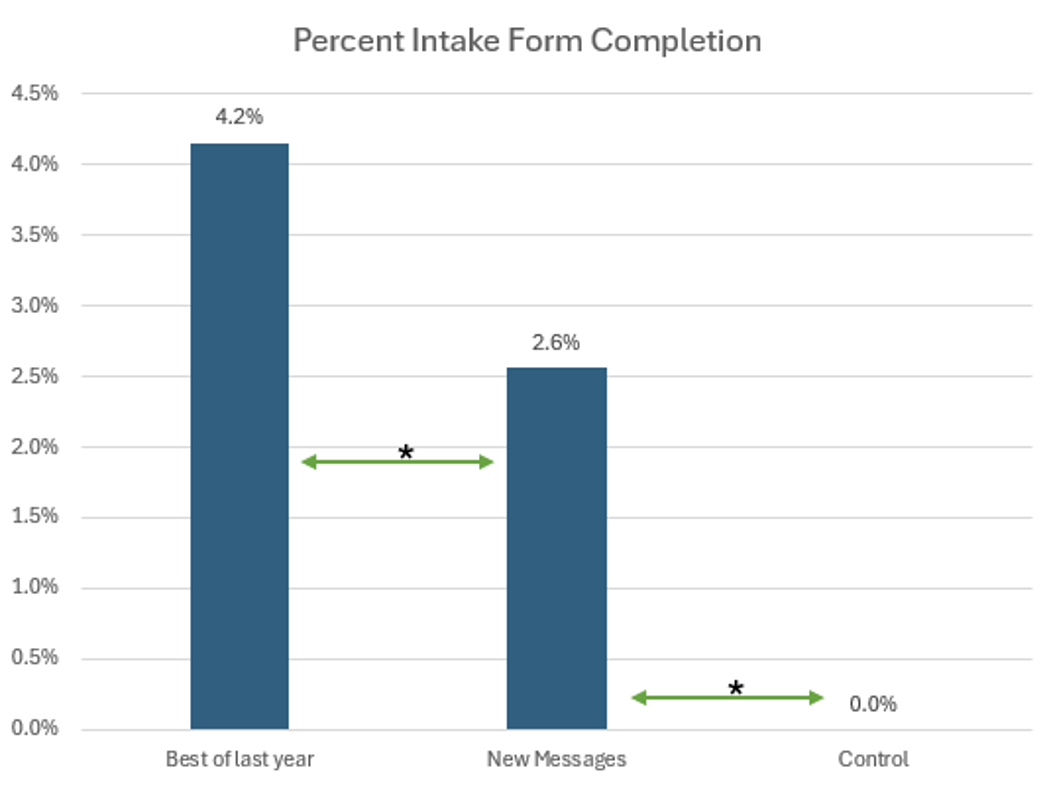
The percentage of intake forms completions was significantly higher after receiving the best messages from previous campaigns than after receiving newly designed messages. Those not receiving messages (control group) did not complete the intake form.
“Working with the ACEEE BEAR Hub has meaningfully improved how EmpowerSaves approach outreach to low- and moderate-income households. Their perspective has helped us better account for the real challenges of communicating with this audience and move away from generic or overly simplistic messaging… As a result, our messaging is more thoughtful, behaviorally grounded, and better aligned with how people actually experience energy costs and assistance programs. This has been a true working partnership that’s strengthened both our strategy and our analysis.” – Jon Milenthal, Partner, EmpowerSaves

Increasing Residential Home Energy Upgrades
Installing home energy upgrades is the most impactful energy-saving behavior homeowners can do in their existing homes. BEAR Hub advisors partnered with utilities and energy organizations to redesign energy assessment reports and encourage homeowners to follow through with energy-saving upgrades...
STEP 1: IDENTIFY A SPECIFIC BEHAVIOR TO CHANGE
Our partners' broad behavioral goal was to encourage more homeowners to follow through with upgrades. Instead of trying to convince all homeowners to consider energy upgrades, the project focused on those already contemplating them—homeowners who had received an energy assessment.
STEP 2: IDENTIFY BARRIERS & BENEFITS FOR THE TARGET AUDIENCE
Homeowners often receive assessment reports that are difficult to understand, overwhelming, or lack clear calls to action. Barriers likely included unclear recommendations, overwhelming report formats, and lack of motivation to act.
STEP 3: BRAINSTORM, PRIORITIZE & SELECT BEHAVIOR CHANGE STRATEGIES
Rather than broad homeowner awareness efforts, the team focused on redesigning reports as a low-cost, low-effort intervention to reduce information overload and enhance follow-through on requesting home energy upgrades.
STEP 4: IMPLEMENT THE BEHAVIOR CHANGE STRATEGIES
The team evaluated and redesigned the reports provided by energy assessors, identifying areas where behavioral science and marketing strategies could improve effectiveness.
STEP 5: EVALUATE THE PROGRAM TO ITERATE AND IMPROVE
We tested the best reports in an online eye-tracking study, and utilities and program implementers adopted the design recommendations included in the best-performing example reports. These reports now help encourage homeowners who received home energy assessments to follow through with recommendations.
More details about this behavior-change strategy can be found here.
Partner with us
We’re here to help you apply behavioral science to your energy programs and challenges.
Consider applying for our no-cost ongoing technical assistance program, where you can receive 4-6 months of:
- behavioral insights to enhance your programs
- implementation support
- collaboration on innovative solutions and pilot projects